Fish AI - AI Fishing App
- 4.7
- Rating
- 100.00K
- Installs
- Free
- Price
 Analysis by App-foxy
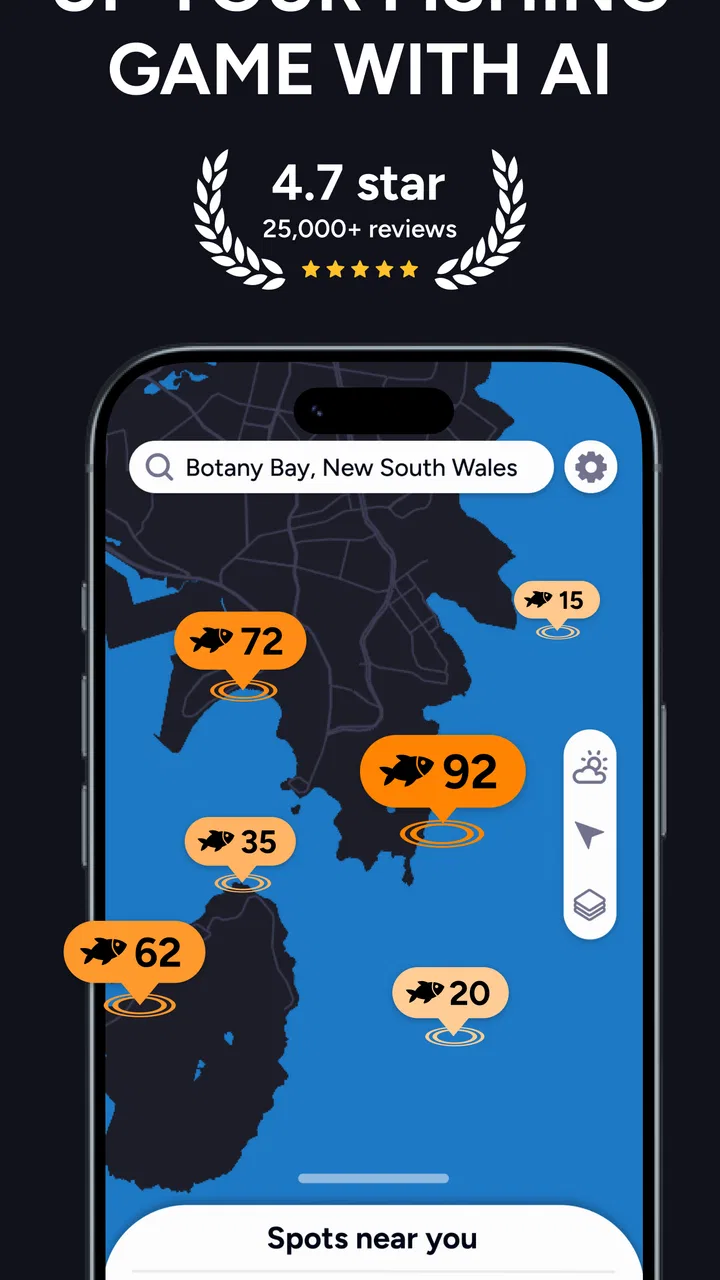
I tried Fish AI as a fishing companion rather than treating it like a simple weather screen, and that distinction matters. Its focus is clear: helping anglers bring together fishing spots, forecasts, and catch information in one place, with an AI-centered approach. I found it most interesting when I used it before deciding where and when to fish, not when I expected it to replace local knowledge or personal judgment.
This is a free sports app from GymBros Inc., rated for Everyone and available for devices running Android 8.0 or later. It has reached over 100 thousand installs and holds a 4.7 average from around 8.3 thousand ratings, which suggests that the idea is connecting with a sizeable group of users. The current version is 1.0.4, and the app was released on July 4, 2025.
How I built a practical fishing routine with the app
My most useful routine started before leaving home. Instead of opening the app only after arriving at the water, I used it as a planning checkpoint: first consider a possible spot, then look at the forecast, and finally use the catch-oriented information to decide whether the trip seemed worth the effort. That order kept the app from becoming a stream of disconnected details.
You May Also Like

 Pandora - Music & Podcasts
Pandora’s Music Is Easy to Start, but Harder to Recover
Pandora’s strength is its low-effort path from a seed to a station. Its weak spot is how much confidence it asks you to place in connection, setup, and quiet recovery.

 AccuWeather: Weather Radar
AccuWeather Review: A Quick, Clear Forecast for Everyday Decisions
For everyday plans, the best forecast is the one you can understand quickly. AccuWeather makes rain timing, radar, and local conditions easy to act on, with a few trade-offs.

 Hill Climb Racing
Why Hill Climb Racing Still Turns Crashes Into One More Run
A tiny car, a bumpy hill and one more upgrade: Hill Climb Racing keeps resurfacing because its simple chaos makes every near-miss feel personal.

 AliExpress - Shopping App
AliExpress Makes Global Shopping Feel Personal, but Shoppers Bear the Risk
AliExpress turns a global marketplace into a pocket-sized discovery engine. Its reach is useful, its shopping loop compelling, and its trade-offs easy to miss.

 Lords Mobile: Kingdom Wars
Lords Mobile Is a Kingdom-Building Routine, Not a Quick Match
A case-by-case verdict on the building, battles, device demands, and social commitments that make Lords Mobile rewarding for some players and exhausting for others.

 PDF Scanner app - TapScanner
TapScanner Makes Paperwork Easier to Capture, Check, and Share
TapScanner makes scanning with a phone feel less like a rescue operation and more like a dependable step in getting work done. Its capture tools are useful, though not flawless.
More From Our News Desk
View All News


The important habit is to treat each part as evidence rather than a promise. A promising forecast does not guarantee a catch, and an interesting catch report does not automatically mean the same conditions will repeat. I found the app more valuable when it helped me ask better questions: Is this location practical today? Does the forecast support the kind of outing I want? Are recent catches useful context, or merely something interesting to browse?
For a realistic weekend example, I would check Fish AI the evening before a short morning trip. I would compare the available spot information with the forecast, then make a simple decision: prepare for the trip, choose another location, or postpone it. In that situation, the app saves more time through preparation than through any single prediction. It helps reduce aimless browsing across separate fishing and weather resources.
I also recommend keeping expectations modest during the first few sessions. An AI fishing tool is easier to judge when you use it repeatedly under different conditions instead of deciding whether it works after one quiet day. Fishing naturally includes variables that an app cannot fully control, so a blank result should not be treated as proof that the guidance was useless.
What I checked before trusting the recommendations
The first thing I looked for was consistency. If the same kind of information appears useful across several outings, it becomes easier to build a personal routine around it. I paid attention to whether the spot and forecast views helped me make a decision quickly, or whether I still needed to jump between unrelated screens and sources.
The catch side of the experience is particularly useful as a reference point. I would not use it as a substitute for knowing the water, local regulations, or seasonal behavior, but it can add context when choosing between familiar options. For someone who fishes casually, that extra context may be enough to turn a vague plan into a more deliberate one.
One non-obvious benefit is that the app encourages a decision-making sequence. Many anglers collect forecasts, locations, and catch reports without connecting them. Fish AI is more helpful when you deliberately connect those pieces: choose the area, inspect the conditions, and then decide what kind of trip makes sense. That workflow is more valuable than simply reading every available detail.
Settings and choices worth checking
I would begin by checking the app’s basic location and forecast context before relying on its suggestions. The quality of a fishing recommendation depends heavily on whether you are looking at the correct area and the conditions relevant to your intended trip. A quick review of the selected place can prevent a surprisingly common mistake: making a decision based on information for somewhere else.
It is also worth deciding how much information you actually need. If I am planning a short outing, I prefer a quick scan of the relevant spot and forecast rather than spending too long exploring every available detail. If I am planning a longer trip, I can afford to compare more information and think through alternatives. The app works best when the amount of checking matches the importance of the trip.
Another useful adjustment is mental rather than technical: separate planning information from confirmation. Forecasts help with preparation, while catch information can help with context. Neither should be read as a guarantee. Keeping that distinction clear makes the app feel more reliable because I am using it for the job it can reasonably perform.
Because the app includes in-app purchases priced from $9.99 to $79.99 per item, I would spend time with the free experience before paying for anything. The free starting point makes that evaluation possible. I would only consider an upgrade if it clearly improves a repeated part of my own fishing routine, rather than purchasing simply because an AI label sounds promising.
Faster patterns for regular users
After a few sessions, I found that the fastest approach was to create a repeatable mental checklist. I would begin with the intended spot, move to the forecast, and finish by considering the catch information. This prevented me from repeatedly reopening the same sections without reaching a decision.
A second useful pattern is to compare two realistic choices instead of browsing without a limit. For example, I might compare the place I already know with another available option, then ask which one better fits the day’s forecast and my available time. This makes the app a decision aid rather than an endless source of possibilities.
I also learned not to overreact to one forecast change. Fishing plans can be flexible, and a single update should prompt a review rather than an immediate cancellation. I would check whether the change actually affects the kind of outing I planned. A short casual session and a full-day trip do not need the same threshold for changing plans.
For experienced anglers, the strongest workflow is probably to use Fish AI alongside personal notes or memory. The app can organize current context, while your own experience supplies details that no general tool can fully capture. If a particular location behaves differently after rain, wind, or a local change, that knowledge remains important. The app becomes more useful when it supports that judgment instead of trying to replace it.
There is also a time-saving habit for beginners: decide in advance what would make the information actionable. If you only want to know whether a quick trip is sensible, do not turn the session into a deep research project. Check the spot, review the forecast, consider the catch context, and make a clear choice. This keeps the experience approachable and avoids confusing more information with better advice.
Where the AI approach helps, and where it stops
The AI angle gives Fish AI a different feel from a basic weather app. A weather service can tell you about conditions, but it does not necessarily frame those conditions around a fishing decision. Likewise, a map can show where places are, while a catch log can show what someone caught. Bringing these ideas together is the app’s most convincing reason to exist.
Still, the app should not be treated as a complete replacement for specialist local knowledge. Fishing depends on water conditions, access, regulations, technique, timing, and details that may not be visible in a general app experience. I would always verify practical and legal considerations separately before setting out. That is not a criticism unique to Fish AI; it is simply the boundary between digital guidance and real-world responsibility.
The same limitation applies to AI-generated suggestions generally. They can help organize information and point attention toward useful possibilities, but they cannot guarantee that a fish will be active or that a particular location will suit your equipment and skill level. I found the app most convincing when it helped narrow a decision, not when I expected certainty.
Compared with using separate fishing apps, weather tools, and general map searches, Fish AI has the advantage of a more focused workflow. The trade-off is that users who already have a trusted collection of specialist tools may not gain enough to justify changing habits. If your current setup already gives you accurate local information and you enjoy managing it yourself, this app may feel more like an additional layer than an essential replacement.
Who will get the most from Fish AI?
I think the app is a good fit for casual anglers who want more structure before a trip. It can also suit newer fishers who are unsure how to combine location, forecast, and catch context. Rather than searching several places and trying to interpret everything independently, they get a single fishing-focused starting point.
It may also appeal to regular users who enjoy experimenting with their routine. Someone who frequently chooses between a few nearby spots can use the app to make those comparisons more deliberate. The value is not necessarily discovering a magical location; it is building a repeatable way to decide where effort is most sensible on a given day.
I would be more cautious about recommending it to anglers who require highly specialized local intelligence, detailed technical tools, or absolute precision. Those users may prefer dedicated resources built around their exact waters and techniques. Fish AI is better viewed as a broad planning companion than as a professional-grade replacement for every fishing reference.
It is also not the right choice for someone who dislikes subscriptions or in-app purchasing models in general. Although the app is free to start, the available purchase range means users should evaluate the unpaid experience carefully and decide whether any paid option offers meaningful value for their own habits.
Small frustrations that affected my experience
The biggest potential friction is the gap between a clean recommendation and the messy reality of fishing. An app can make planning feel organized, but the water may still behave differently from the forecast or recent catch context. Users who expect a direct answer every time may become disappointed quickly.
I also think the AI positioning can create unrealistic expectations for beginners. The word suggests intelligence and personalization, but a helpful suggestion is not the same as a guaranteed result. I would explain this to a friend before recommending it: use the app to improve preparation, not to outsource every decision.
Another trade-off is that combining several kinds of information can make the experience feel more involved than opening a simple forecast app. That extra involvement is worthwhile when planning matters, but unnecessary when you only want a quick glance at conditions. The app is strongest for intentional trips and less compelling for a user who wants nothing beyond a fast weather check.
The Everyone rating makes it broadly approachable, and the low minimum operating-system requirement means it can work on older compatible devices. Even so, accessibility in the age-rating sense does not mean every angler will find the workflow equally simple. New users should give themselves a few sessions to understand how the spot, forecast, and catch elements fit together.
My final view after using it as a fishing companion
Fish AI is most successful when I use it as a planning framework. Its combination of spots, forecasts, and catch information gives me a more fishing-specific starting point than a general weather or map app. The free entry point is helpful, and the strong 4.7 average shows that many users have responded positively to the experience.
I would recommend it to a friend who wants to make fishing plans more deliberate without assembling several separate tools. My advice would be to begin with the free version, use the same simple workflow across multiple outings, and judge it by whether it saves time or improves decisions. That is a more useful test than expecting immediate proof from one trip.
For me, the winning habit is simple: select a realistic spot, check the conditions, use catch information as context, and keep personal judgment in charge. The app is best when it sharpens your preparation rather than pretending to eliminate uncertainty. That makes it a worthwhile sports app for curious and casual anglers, while experienced users with highly specialized local systems may find that their existing tools remain the better choice.
With GymBros Inc. behind it and version 1.0.4 currently available, the app feels like a focused option for anglers interested in an AI-assisted approach. I would not call it essential for every fishing trip, but I can see its value in the repeatable routine it encourages. Used with realistic expectations, Fish AI can turn scattered planning into a clearer decision about whether, where, and when to fish.
FAQs for Fish AI - AI Fishing App
01What is Fish AI - AI Fishing App and how does it work?
Fish AI - AI Fishing App is a cutting-edge application designed to enhance your fishing experience using artificial intelligence. It analyzes environmental data, such as weather conditions, water temperature, and fish activity, to provide real-time advice and predictions on the best fishing spots and times. The app aims to increase your chances of a successful catch by combining technology with traditional fishing techniques.
02Is Fish AI suitable for beginners in fishing?
Yes, Fish AI is designed to be user-friendly for both beginners and experienced anglers. The app provides detailed tutorials and guidance on how to use its features effectively. Beginners can benefit from the AI-driven insights and recommendations, making it easier to understand fishing patterns and improve their skills over time.
03Does Fish AI require an internet connection to function?
Fish AI requires an internet connection for initial setup and to access real-time data for accurate predictions. However, once the necessary information is downloaded, the app can function offline. This allows users to access previously downloaded data and recommendations even when they are in remote areas without internet access.
04What kind of data does Fish AI use to make fishing predictions?
Fish AI utilizes a variety of data sources to make accurate fishing predictions. It gathers information on weather conditions, water temperature, moon phases, and historical fish activity patterns. By analyzing this data, the app can provide personalized advice on the best times and locations for fishing, tailored to the user’s specific location and preferences.
05Is Fish AI available for both Android and iOS devices?
Yes, Fish AI is available for download on both Android and iOS platforms. Users can find the app on the Google Play Store and Apple App Store. The app is regularly updated to ensure compatibility and provide new features, making it accessible to a wide range of smartphone users.
Pros
- Accurate fish species identification.
- Real-time weather and tide updates.
- User-friendly interface.
- Extensive database of fishing spots.
- Customizable alert notifications.
Cons
- Requires constant internet connection.
- Limited free features.
- Ads can be intrusive.
- Some fish data may be outdated.
- Battery consumption is high.

Fish AI - AI Fishing App
Gallery